The purpose of the project selection procedure BG14MFOP001-2.005 "Aquaculture providing ecological services" is to compensate for the additional costs and / or lost benefits in the cultivation of aquaculture providing ecological services.
Compensations under measure 2.5 "Aquaculture, providing environmental services", according to Art. 54 (1) (a) of Regulation № (EC) 508/2014 shall be paid to beneficiaries who use aquaculture farming methods compatible with the specific needs of the environment and subject to specific management requirements as a result of the zoning Natura 2000 in accordance with Directives 92/43 / EEC and 2009/147 / EC. As a result of the application of these methods, they suffer a loss of income from their production. The implementation of a compensation system for holdings in NATURA 2000 sites also depends on the management plans of the protected areas.
After surveys among aquaculture producers and data provided by environmental organizations, it was found that the greatest damage to aquaculture farms is caused by birds that inhabit these sites. Our country is part of the Via Pontica bird route, which determines their large number at certain times of the year and their accumulation on the territory of the reservoirs, including the places where aquaculture is grown.
According to data provided by the Institute of Biodiversity and Ecosystem Research at the Bulgarian Academy of Sciences, the largest population is the small cormorant, reaching from 7,000 to 13,000 birds, mainly in the Burgas Lakes region. The daily consumption is 200 g of fish per day. This species is endangered and falls in the Red Book of the Republic of Bulgaria.
The critically endangered species is the Dalmatian Pelican. An average of 753 birds winter in the Burgas Lakes region. Between August 10 and October 30, an average of 208 migratory birds were found there. The daily consumption of this species is 1,123 g of fish per day.
The pink pelican is also a protected species and is included in the Red Book of the Republic of Bulgaria. An average of 90 birds spend the winter in the Burgas Lakes region. Between August 10 and October 30, an average of 21,000 migratory birds were found there. The daily consumption of this species is 1,200 g of fish per day.
The Gray Heron is included in the Red Book of the Republic of Bulgaria. Estimates of nesting numbers vary, with an average of 500-700 pairs. This species not only feeds on fish, but also damages aquaculture farms in the places it usually inhabits - the Danube and Black Sea coasts, the Fore-Balkans and the valleys of larger rivers.
The other species with a population of 7,000 birds throughout the country is the great cormorant. This species does not fall into the Red Book of the Republic of Bulgaria. The daily consumption of this species is 500 g of fish per day.
The lost income is expressed as a loss from predation. The calculation of damages is based on the damages of the above types. Damage from other species or the theoretical value of ecosystem services is neglected.
The project of Tundzha-73 EOOD foresees the application of methods for growing and breeding aquaculture in a full-scale fish farm, compatible with the specific needs of the environment and subject to specific management requirements as a result of the designation of Natura 2000 protected areas, including environmental protection. , biodiversity and traditional characteristics of aquaculture areas.
The territory of the fish farm falls within the Protected Area for Protection of Wild Birds BG0002052 "Zhrebchevo Dam" and is bound by the observance of prohibitions and restrictions arising from the Management Plan of the area.
The project is related to the conservation of species that are included in the Red Book of the Republic of Bulgaria and / or Annex 3 of the Biodiversity Act - Cormorant (Phalacrocorax pygmeus), Gray Heron (Ardea cinerea), Pink Pelican (Pelecanus onocrotalus), Dalmatian pelican (Pelecanus crispus).
Production in a fish farm, Nikolaevo is subject to compliance with prohibitions and restrictions arising from the Management Plan of the protected area.
The following activities are set for implementation in the project:
- Activity for maintenance of the environmental conditions and protection of the natural habitats in the protected area - it envisages non-use of sound generating devices and other methods for driving away the fish-eating birds in the breeding zone in the period 15 December - 15 July, as well as no activities , such as mowing, uprooting reeds and rushes, destruction of other aquatic vegetation, destruction of woody vegetation while maintaining the dikes and growing outside the peripheral dikes of the farm, carrying out scheduled repairs of hydraulic facilities in the period March 15 - July 15. Start filling the pools and stocking them no later than May. Shortening the duration of feeding the fish in the breeding area until the end of June in order to minimize the generation of noise and disturbance through the movement of agricultural machinery by applying a single feed for the day. The pools in the breeding area will be stocked with biennial and annual fish in order to minimize the catch of fish during the growing season and reduce the disturbance of birds.
- Activities leading to increase of the food base of the species subject to protection - it envisages maintenance of at least 10% of stocked water area of the farm area during the winter period of catching and selling fish and 100% during the vegetation period coinciding with the breeding and nesting of birds subject to protection in the protected area. Feeding the fish (during the active months when it feeds) to maintain a rich nutritional base for fish-eating birds. Settlement of small fish (annual and biennial) in the pools in the breeding area of birds in order to create a food base.
- Actions for prevention of violators - this activity provides for constant video surveillance of the area of the farm within the scope of the video surveillance system (up to 6 km.), Through the established thermal imaging system. Prevention of poaching activities leading to the destruction of bird habitats in the area of the farm through their own protection and in coordination with law enforcement agencies.
- Dissemination of knowledge and experience - providing for the development of a website to promote the results of the project and dissemination of knowledge and experience regarding the protection, restoration and sustainable use of the environment.
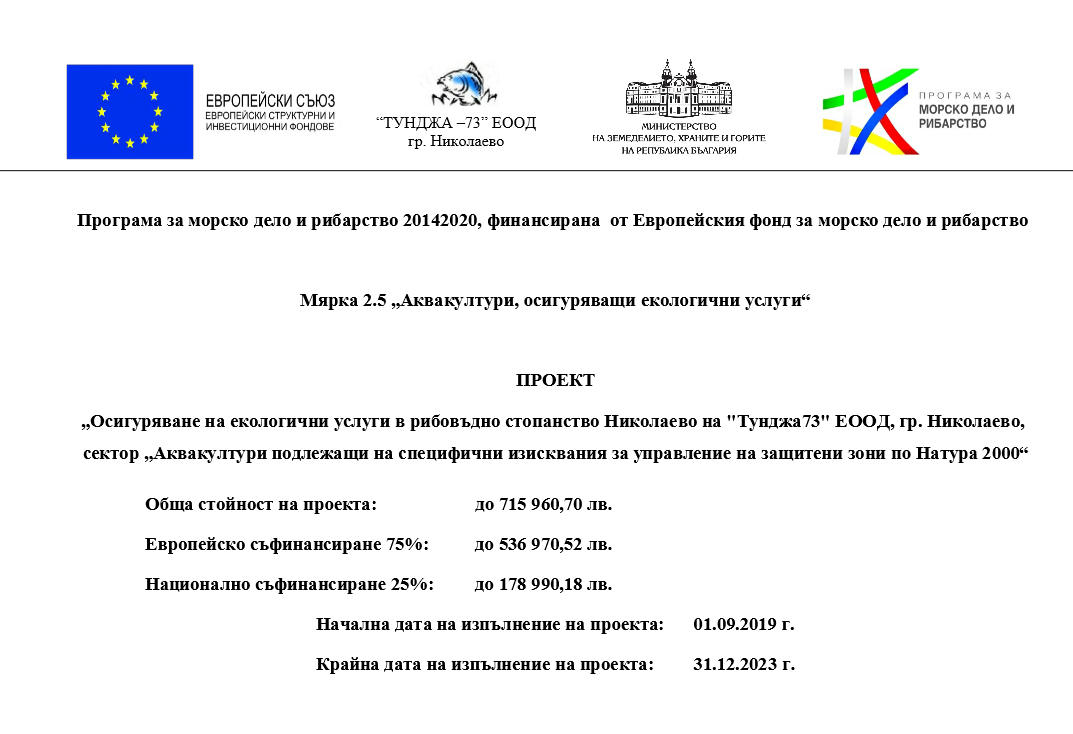
Starting date of the project is September 1, 2019.
The final date of project implementation is 31.12.2023.
The total value of the project is up to BGN 715,960.70, of which European co-financing 75% (up to BGN 536,970.52) and national co-financing 25% (up to BGN 178,990.18)