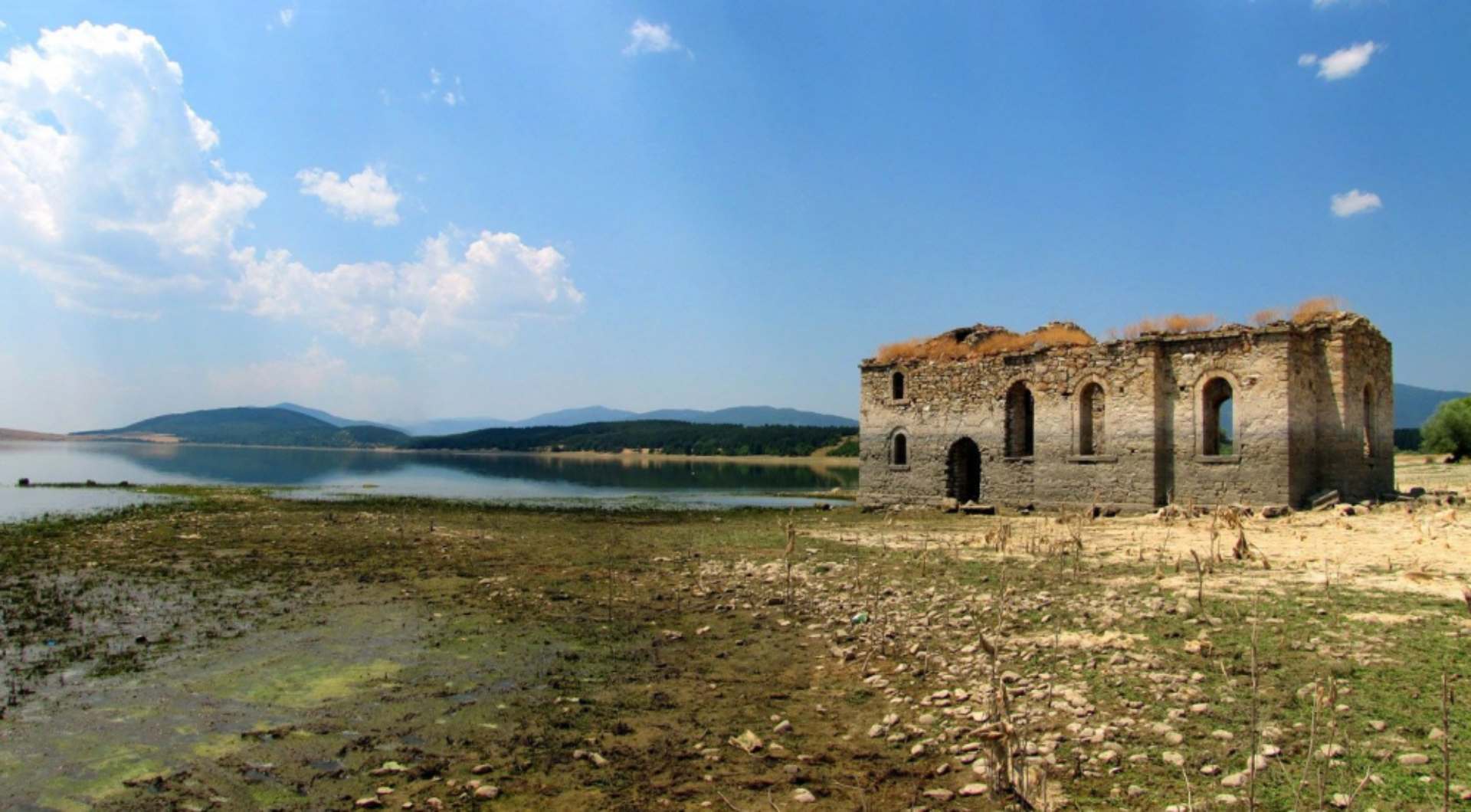
Zhrebchevo Dam Protected Area falls on the territory of four municipalities - Nikolaevo, Gurkovo (Stara Zagora district), Tvarditsa and Nova Zagora (Sliven district). In terms of physiography, the area is located in the Trans-Balkan valleys.
The territory of the protected area has a total area of 25,126,091 decares. According to the way of permanent use, the lands on the territory of the protected zone are as follows:
- Water areas - 25,073,585 decares or 99.79% of the protected area;
- Transport infrastructure - 0.207 decares;
- Agriculture - 52,299 decares or 0.21% of the protected area.
Subject of protection in the protected area "Zhrebchevo Dam" are 14 species of birds under Article 6, para. 1, item 3 of the Law on Biological Diversity (habitat protection of species under Council Directive 79/409 / EEC on the conservation of wild birds). Apart from those, under Art. 6, p. 1, item 4 of the Biodiversity Act, another 27 species appear in the order for declaring the zone (protection of territories in which during breeding, moulting, wintering or migration significant quantities of birds of species accumulate).
According to the order for its declaration, the protected area "Zhrebchevo Dam" aims to:
- protection and maintenance of the habitats of the bird species indicated in the management plan in order to achieve their favorable conservation status - species under Art. 6, para. 1, item 3 of the Law on Biological Diversity: black-throated diver (Gavia arctica), small cormorant (Phalacrocorax pygmeus), large water bull (Botaurus stellaris), great white egret (Egretta alba), swan (Cygnus cygnus), small diver (Mergus albellus), red-breasted goose (Branta ruficollis), black pitcher (Milvus migrans), sea eagle (Haliaeetus albicilla), reed bunting (Circus aeruginosus), field buzzard (Circus cyaneus), white-tailed buzzard (Buteo rufinus), evening buzzard Falco vespertinus), tern (Alcedo atthis);
- protection and maintenance of the habitats of the bird species indicated in the management plan in order to achieve their favorable conservation status - species under Art. 6, para. 1, item 3 of the Law on Biological Diversity: black-throated diver (Gavia arctica), small cormorant (Phalacrocorax pygmeus), large water bull (Botaurus stellaris), great white egret (Egretta alba), swan (Cygnus cygnus), small diver (Mergus albellus), red-breasted goose (Branta ruficollis), black pitcher (Milvus migrans), sea eagle (Haliaeetus albicilla), reed bunting (Circus aeruginosus), field buzzard (Circus cyaneus), white-tailed buzzard (Buteo rufinus), evening buzzard Falco vespertinus), tern (Alcedo atthis).
The activities influencing the subject of protection are:
- Water consumption. The annual fluctuations at the water level, with large amplitudes, have a serious negative impact on the living organisms inhabiting the reservoir and on the quality of the water volumes.
- Aquaculture - In the area of the protected area "Zhrebchevo Dam" operate three fish farms. floating cages fish farms do not have a direct impact on the subject of protection. Unused food and excrement excreted in the water contain a high concentration of nutrients and are the cause of eutrophication of water bodies where cage farms are built.
- Hunting and fishing - the impact of hunting on the object of conservation is minimal. Unfortunately, numerous violations and poaching are found every year. The fishing practiced in the PA can be divided into industrial and recreational. Recreational fishing can have an impact on fishermen's concern for the birds inhabiting the area. A negative effect of industrial fishing is the concern on the object of conservation.
- Agriculture - The most developed branch of agriculture in the region is crop production. A part of the lands around the PA are used for forestry and logging.
Most of the territory of the Zhrebchevo Dam Protected Area is occupied by artificial water areas. The following habitat categories can be differentiated on the territory of the zone, entirely of anthropogenic origin or to varying degrees of human influence:
A / Water areas - artificial reservoirs with a total area of 25073 decares. The following subtypes of habitats can be distinguished in them, each with characteristic features and inhabitants:
- littoral - the shallow areas along the coastline, which often remain dry during fluctuations in the water level. The depth is from 0 to 0.4 m. The area is represented mainly in Nikolaevo fishponds with an area of about 1000 decares, in the area overgrown mainly with ferns (Typha) and less with reeds (Phragmites). The strip with these indicators in Zhrebchevo dam is narrow and variable. The main inhabitants are the members of the families Ardeidae, Anatidae, Charadriiformes;
- sublittoral - open water area with a depth of 1 - 1.5 m. This is the depth at which most species of birds looking for food by wading or swimming, without being good divers, reach the bottom. It is inhabited by almost all species of waterfowl, subject to protection in the area. It is presented mainly at Nikolaevo fishponds (about 2100 decares), in Zhrebchevo dam similar areas appear temporarily when the water level drops within certain limits in some of the shallow bays. At maximum filling at elevation 264 they are too deep, but at the levels of elevations 254 - 260 there are extensive sections with the required depth. At lower levels, they remain on land, and the slope of the bottom of the flooded sections is greater and the section with similar characteristics is too small.
- profundal - open water area with a depth of over 1.5 m. Occupies the largest share of water basins - about 20,800 decares. It is inhabited mainly by representatives of the families Geese (Anserinae), Seagulls (Laridae), Divers (Gaviidae), Pelicans (Pelecanidae), Cormorants (Phalacrocoracidae) and representatives of other taxa, which are good swimmers and divers. The terms used to denote the ecological zoning of water areas are borrowed from oceanology and are interpreted quite conventionally for freshwater basins with shallow depths, such as those discussed here.
B/ Wet floodplain meadows in the vicinity of water bodies. A water management facility is being built along the UTP, but for the most part there are sections with a slight slope on the periphery of the dam, flooded for 2-3 months almost every year. Some of them are plowed, sown with cereals and declared for direct payments by tenants-farmers in violation of the law. They play a role mainly as a habitat for a number of species of vertebrates and invertebrates, serving as food for the species subject to conservation. Hunting field for the order Falconiformes and for the species of the stork family (Ciconiiformes).
C/ Forests in agricultural lands - individual trees or strips of woody vegetation along canals and ravines within or along the boundaries of the PA. Small in area - 100 - 150 decares in total for the whole area, fragmented. Strongly modified in composition remnant of riparian forests. The nesting habitat of the common buzzard (Buteo buteo), the white-tailed buzzard (Buteo rufinus), the black buzzard (Milvus migrans), the little hawk (Accipiter nisus), the Kerkenes (Falco tinuncullus), the evening kestrel (Falco vespertinus), the gray heron (Ar).
The data on the ichthyofauna give grounds to believe that the food base for the fish-eating birds in Zhrebchevo dam is not sufficient and this is one of the reasons for their accumulation in the aquatorium of Nikolaevo fish farms (Tundzha-73 fish farm). It was found that the high values of biomass in Nikolaevo fishponds are similar to the reported values in Lake Durankulak, Srebarna, Shabla, Barzina Dam, Mandra Dam and Pchelina Dam. It is noteworthy that most of the listed reservoirs are ornithologically important places. It can be assumed that not only the location of the reservoirs but also their trophic status (the ability to maintain the necessary food base) determine the preferences of birds to them.
According to the assessment of the threats in the Zhrebchevo Dam Protected Area, a high degree of threat is represented: water pollution with nitrogen and phosphorus fertilizers, pollution of the Tundzha River immediately above the Protected Areas with manure from the existing cow farm, discharge of domestic water from the settlements in the reservoirs of the protected area, the fluctuations of the water level, deliberate expulsion and killing of birds in the fish farms, poaching - shooting of protected species and hunting on the territory of the fishponds, the construction of renewable energy sources and in particular solar and wind farms. of protection for important habitats of the species, object of protection, in close proximity to the PA, lack of land sections, as part of the territory of the PA, to perform the role of a buffer zone.
The fishing practiced in the PA can be divided into industrial and recreational. Industrial fishing is practiced only on the territory of fish farms in Nikolaevo. In principle, recreational fishing can have an impact on the birds inhabiting the area through fishermen's concern. In this case, its impact is not high due to the fact that the flocks of birds and the months in which they are most vulnerable coincide with the winter season and the ban on fishing in the spring.
A negative effect of industrial fishing is the concern on the object of conservation. To avoid it, it is necessary to clarify the places and periods of accumulation of bird species and to introduce temporary restrictions that are in line with the main purpose of the IF and do not affect (or minimally affect) the interests of fish farmers. Where this is not possible (as in the case of the fishery area), legal persons should be compensated for the restrictions they must comply with and affect their income, as well as for the direct losses caused by fish-eating birds.
Regimes operating on the territory of the protected area.
Within the boundaries of the protected area are prohibited:
- the removal of landscape features (borders, single or groups of trees) in the use of agricultural land as such;
- afforestation of meadows, pastures, what and their conversion into arable land and perennials;
- the use of pesticides and mineral fertilizers in pastures and meadows;
- reduction of the area of riparian forests of native tree species;
- burning of reeds and coastal vegetation;
- mowing of reeds in the period from March 1 to August 15.
Prohibitions, regimes, recommendations introduced by the management plan for the entire territory of the protected area:
- Change of land use, except in the interest of public health and safety or in cases where the changes lead to extremely favorable consequences for the environment;
- Construction of RES (solar and wind energy installations);
- Afforestation with non-native species;
- Boat hunting;
- Construction of new and expansion of the capacity of the existing cage farms;
- Plowing and use of fertilizers and pesticides in properties with №№ 181.586, 184.531, 184,677, 700.687, 700.706, 700.993;
- Maintenance of the water level of Zhrebchevo dam from April 15 to May 31 without significant amplitudes (within + 40 / - 10 cm), as the level on April 15 is assumed to be the level "0";
- Maintenance of a safe high and constant water level (up to the level of the overflow) in the bed of the Tundzha River above the dam at Nikolaevo fishponds, in the period from April 15 to May 31;
- Limiting the eutrophication of Zhrebchevo Dam. For this purpose, it is necessary to carry out activities in four directions: 1. Limiting the use of fertilizers, nitrogen and phosphorus-containing pesticides. 2. Liquidation of the illegal landfills for household waste and discharges of municipal wastewater around the dam of the dam and along the Tundzha River and the small tributaries flowing into the dam. 3. Afforestation of the edges of the arable lands, the banks of the ravines and the shoreline of the dam with a vegetation belt of suitable trees and shrubs. 4. Maintenance of the properties described in item 3.2.2 in their natural state - floodplain wet meadows and pastures;
- Carrying out activities for environmentally friendly control of zebra mussels (Dreissena polymorpha) and other aggressive exotics of plant and animal origin.
Prohibitions, regimes, recommendations, introduced with IF and according to the zoning of PA "Zhrebchevo Dam" for the territory of REPRODUCTION ZONE
On the territory of the REPRODUCTION ZONE it is prohibited:
- The use of sound generating devices and other methods for repelling fish-eating birds in the period December 15 - July 15;
- Carrying out fishery, agricultural and livestock activities / activities leading to habitat destruction or disturbance in breeding birds in the period 15 March - 15 July. This includes:
- mowing, uprooting reeds and rushes;
- destruction of other aquatic vegetation;
- mowing of meadows and pastures;
- destruction of woody vegetation while maintaining the dikes in Nikolaevo fishponds in the period March 15 - July 15;
- destruction of woody vegetation growing outside the peripheral dikes of Nikolaevo fishponds; - Carrying out scheduled repairs of the hydraulic facilities in the period March 15 - July 15;
The accumulation of a large number of fish-eating birds in places with intensive fish production is a natural process. These accumulations can lead to significant losses and even bankruptcy of the fish farm. The only way to protect the birds and preserve the livelihood of the population is to find a mechanism to compensate for the losses. Because in the PA for birds, fish-eating species cannot simply be isolated from their diet, because this would endanger their populations in the area (in Romania, the method of isolating the water surface with the help of nets or densely placed steel ropes is widely practiced. outside the PA), the only possible alternative is to fully cover the damage to holdings covered by or in the vicinity of the PA for birds, so that aquaculture producers are interested in continuing their activities, voluntarily complying with all bans (as achieved in Hungary and Czech Republic).
The table below selects all species of birds established in the PA and listed in Annex II of the BDA and / or in the order for declaring the area. Their conservation status is indicated, according to national and international documents.
|
Species |
1% Ramsar criterion |
IUSN red list |
Red Book of Bulgaria |
BERN |
BONN |
BDA |
|
Black-throated Diver Gavia arctica |
2 |
2 |
2, 3 |
|||
|
Red-breasted Diver Gavia stellata |
2 |
2 |
2 |
|||
|
Black-necked Diver Podiceps nigricollis |
CR |
2 |
3 |
|||
|
Slavonian grebe Podiceps auritus |
2 |
2 |
2 |
|||
|
Small diver Tachybaptus ruficollis |
VU |
3 |
3 |
|||
|
Pink pelican Pelecanus onocrotalus |
RE |
2 |
1,2 |
2, 3 |
||
|
Dalmatian Pelican Pelecanus crispus |
VU |
CR |
2 |
1,2 |
2, 3 |
|
|
Common cormorant Phalacrocorax carbo |
3 |
|||||
|
Small cormorant Phalacrocorax pygmeus |
EN |
2 |
2 |
2, 3 |
||
|
Night heron Nycticorax nycticorax |
VU |
2 |
2, 3 |
|||
|
Small water bull Ixobrychus minutus |
EN |
2 |
2 |
2, 3 |
||
|
Large water bull Botaurus stellaris |
EN |
2 |
2 |
2, 3 |
||
|
Maned heron Ardeola ralloides |
EN |
2 |
2, 3 |
|||
|
Little Egret Egretta garzetta |
NT |
2 |
2, 3 |
|||
|
Gray Heron Ardea cinerea |
VU |
3 |
3 |
|||
|
Red heron Ardea purpurea |
EN |
2 |
2 |
2, 3 |
||
|
Great Egret Egretta alba |
CR |
2 |
2, 3 |
|||
|
Black stork Ciconia nigra |
VU |
2 |
2 |
2, 3 |
||
|
White stork Ciconia ciconia |
VU |
2 |
2 |
2, 3 |
||
|
Eurasian spoonbill Platalea leucorodia |
CR |
2 |
2 |
2, 3 |
||
|
Brilliant ibis Plegadis falcinellus |
CR |
2 |
2 |
2, 3 |
||
|
Mute swan Cygnus olor |
VU |
3 |
2 |
3 |
||
|
Pointed swan Cygnus cygnus |
EN |
2 |
2 |
2, 3 |
||
|
Tundra swan Cygnus columbianus |
CR |
2 |
2 |
2 |
||
|
Gray goose Anser anser |
EN |
3 |
2 |
3 |
||
|
Greater white-fronted goose Anser albifrons |
3 |
2 |
||||
|
Lesser white-fronted goose Anser erythropus |
VU |
CR |
2 |
1,2 |
2, 3 |
|
|
Red-breasted Goose Branta ruficollis |
VU |
VU |
2 |
1,2 |
2, 3 |
|
|
Ruddy shelduck Tadorna ferruginea |
CR |
2 |
2 |
2, 3 |
||
|
White angel Tadorna tadorna |
VU |
2 |
2 |
3 |
||
|
Green-headed duck Anas platyrhynchos |
3 |
2 |
||||
|
Northern pintail Anas acuta |
3 |
2 |
||||
|
Eurasian green-winged teal Anas crecca |
3 |
2 |
||||
|
Eurasian wigeon Anas penelope |
3 |
2 |
||||
|
Common pochard Aythya ferina |
VU |
3 |
2 |
3 |
||
|
White-eyed diver Aythya niroca |
NT |
VU |
3 |
1,2 |
2, 3 |
|
|
Tufted duck Aythya fuligula |
3 |
2 |
||||
|
Bellflower Bucephala clangula |
||||||
|
Red-breasted merganser Mergus serrator |
3 |
2 |
3 |
|||
|
Smew Mergus albelus |
2 |
2 |
2, 3 |
|||
|
Reed bunting Circus aeruginosus |
EN |
2 |
2 |
2, 3 |
||
|
Polish Blar Circus cyaneus |
CR |
2 |
2 |
2, 3 |
||
|
Meadow weevil Circus pygargus |
VU |
2 |
2 |
2, 3 |
||
|
Short-toed hawk Accipiter brevipes |
VU |
2 |
2 |
2, 3 |
||
|
White-tailed buzzard Buteo rufinus |
NT |
2 |
2 |
2, 3 |
||
|
Small eagle Aquila pomarina |
VU |
2 |
2 |
2, 3 |
||
|
Rock eagle Aquila chrysaetos |
VU |
2 |
2 |
2 |
||
|
Imperial eagle Aquila heliaca |
VU |
CR |
2 |
1,2 |
2, 3 |
|
|
Small eagle Hieraaetos pennatus |
VU |
2 |
2 |
2 |
||
|
Sea eagle Haliaeetus albicilla |
VU |
2 |
1,2 |
2, 3 |
||
|
European honey buzzard Pernis apivorus |
LC |
2 |
2 |
2 |
||
|
Eagle fisherman Pandion haliaetus |
CR |
2 |
2 |
2, 3 |
||
|
Evening Kestrel Falco vespertinus |
NT |
NT |
2 |
2 |
2, 3 |
|
|
Small falcon Falco columbarius |
2 |
2 |
2, 3 |
|||
|
Falcon peregrinus peregrine falcon |
EN |
2 |
2 |
2, 3 |
||
|
Black pitcher Milvus migrans |
VU |
2 |
2 |
2, 3 |
||
|
Eagle snake Circaetus gallicus |
VU |
2 |
2 |
2, 3 |
||
|
Gray crane Grus grus |
RE |
2 |
2 |
|||
|
Water rail Rallus aqaticus |
NT |
3 |
||||
|
Eurasian coot Fulica atra |
3 |
2 |
||||
|
Northern lapwing Vanellus vanellus |
LC |
3 |
2 |
|||
|
Burilius oedicnemus |
VU |
2 |
2 |
2, 3 |
||
|
Stilt walker Himantopus himantopus |
EN |
2 |
2 |
2, 3 |
||
|
Sable beak Recurvirostra avosetta |
EN |
2 |
2 |
2, 3 |
||
|
Three-toed runner Calidris alba |
2 |
2 |
||||
|
Green sandpiper Tringa ochropus |
EN |
2 |
2 |
3 |
||
|
Wood sandpiper Tringa glareola |
2 |
2 |
2, 3 |
|||
|
Pastroop. coastal snipe Limosa laponica |
3 |
2 |
2 |
|||
|
Ruff Philomachus pugnax |
3 |
2 |
2, 3 |
|||
|
Mediterranean gull Larus melanocephalus |
VU |
2 |
2 |
2, 3 |
||
|
Seagull Larus canus |
3 |
3 |
||||
|
River gull Larus ridibundus |
EN |
3 |
3 |
|||
|
Yellow-legged Gull Larus cachinnans |
3 |
|||||
|
Silver gull Larus argentatus |
||||||
|
Little gull Larus minutus |
2 |
2 |
||||
|
White-tailed Tern Chlidonias hybridus |
VU |
2 |
2, 3 |
|||
|
Blackfish Chlidonias niger |
CR |
2 |
2 |
2, 3 |
||
|
Caspian tern Sterna caspia |
2 |
2 |
2, 3 |
|||
|
River tern Sterna hirundo |
EN |
2 |
2 |
2, 3 |
||
|
Gull-billed tern Gelochelodon nilotica |
EN |
2 |
2, 3 |
|||
|
Common kingfisher Alcedo atthis |
2 |
2, 3 |
||||
|
Barn Owl Asio flameus |
2 |
2 |
2, 3 |
|||
|
Black woodpecker Driocopus martius |
VU |
2 |
2 |
|||
|
Syrian woodpecker Dendrocopos syriacus |
2 |
2, 3 |
||||
|
Field kidney Anthus campestris |
2 |
2, 3 |
||||
|
Red-backed Shrike Lanius colurio |
2 |
2, 3 |
||||
|
Black-headed Shrike Lanius minor |
2 |
2, 3 |
||||
|
White-headed Shrike Lanius nubicus |
VU |
2 |
2, 3 |
|||
|
Barred warbler Silvia nisoria |
2 |
2 |
2 |